

 日本語
日本語 Tiếng Việt
 中文
中文 한국어
한국어 Login
Login





In Vietnamese, the words “mọi” and “mỗi” are frequently used in daily conversation. At first glance, they might seem similar, and many learners find them confusing. Even though their tones are slightly different, their meanings are entirely distinct. In this lesson, we will introduce the usages of both “mọi” and “mỗi”.
“mọi” = “All”, “Every”
Structure:
By placing “mọi” before a noun, it takes on an inclusive meaning, referring to “all” things or people belonging to that noun category as a whole group.
① Mời mọi người ổn định chỗ ngồi để buổi hội thảo được bắt đầu.
Ladies and gentlemen (everyone), please take your seats so the seminar can begin.
② Mọi hôm anh ấy về nhà lúc 6 giờ tối, nhưng hôm qua đến tận 9 giờ tối anh ấy mới về.
Usually (On all other days), he comes home at 6 PM, but yesterday he didn’t return until 9 PM.
③ Cô ấy đã hoàn thành mọi công việc được giao.
She has completed all the assigned tasks.
④ Mọi khi tôi vẫn hay ra ngoài ăn tối, nhưng hôm nay tôi quyết định sẽ tự nấu ăn.
As usual (Like every other time), I would go out for dinner, but today I decided to cook for myself.
⑤ Tôi tin rằng mọi khó khăn rồi sẽ vượt qua.
I believe that all difficulties will eventually be overcome.
* Also, when describing a situation, phrases like “tất cả mọi + Noun” (all of…) or “hầu hết mọi + Noun” (almost all of…) are used. By adding “tất cả” or “hầu hết” before “mọi”, you can specify whether you are referring to the entirety or just the majority of the group.
① Tất cả mọi thứ đều đã được chuẩn bị sẵn sàng cho sự kiện ngày mai
Everything (All things) has been prepared for tomorrow’s event.
② Trong bài kiểm tra lần này, hầu hết mọi người đều đạt điểm cao.
In this test, almost everyone got high scores.
“mỗi” = “Each”, “Every (single)”
Structure:
Unlike “mọi”, which focuses on the group as a whole, “mỗi” focuses on the individuals within the group, meaning “each” or “every single one”.
① Ở nhà tôi, mỗi phòng đều có gắn máy điều hòa
In my house, each room is equipped with an air conditioner.
② Mặc dù gặp nhau hằng ngày, nhưng mỗi khi gặp nhau họ đều có chuyện để nói.
Even though they meet every day, each time they meet, they always have something to talk about.
③ Tôi thường đi du lịch nước ngoài vào mỗi mùa hè.
I usually travel abroad each summer.
④ Mỗi lần về quê, anh ấy đều mua rất nhiều quà cho mọi người trong gia đình.
Each time he returns to his hometown, he buys lots of gifts for everyone in his family.
* To avoid confusing the usage of “mọi” and “mỗi”, please remember the conceptual image below.
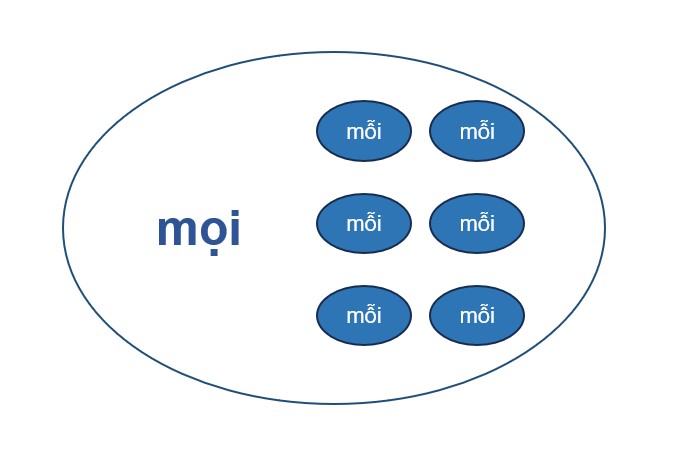
Fig. Conceptual image of “mọi” and “mỗi”
【QUIZ】
Fill in the blanks appropriately using “mọi” or “mỗi”.
① Anh trai tôi tham gia tình nguyện viên tại bệnh viện ____ tháng một lần.
My brother volunteers at the hospital once ____ month.
② Đối với tôi, ____ lần vấp ngã là một lần trưởng thành.
For me, ____ time I stumble is a time I grow.
③ Boss: Tiến độ dự án như thế nào rồi?
How is the progress of the project?
Employee: ____ công việc đều tiến triển suôn sẻ và dự kiến hoàn thành theo đúng thời hạn.
____ tasks are progressing smoothly and are expected to be completed on time.
④ Nam: Dạo này công việc của cậu thế nào?
How is your work lately?
Linh: Công việc của tớ vẫn như ____ khi, không bận lắm đâu.
My work is just like ____ other time (as usual), not very busy.
Nam: Vào ____ cuối tuần, cậu thường làm gì?
What do you usually do ____ weekend?
Linh: Tớ chơi cầu lông với bạn vào ____sáng chủ nhật
I play badminton with friends ____ Sunday morning.